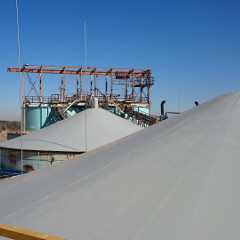
Harmony Gold Steyn 1
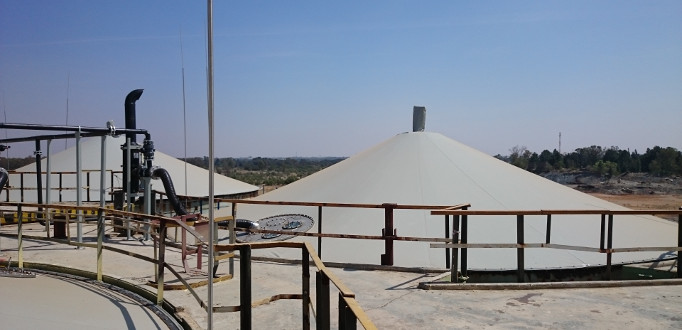
A complete biogas train for an anaerobic digestion plant: roofs, buffer storage, chilling, boosting and flaring.
View
As fossil fuel demand and prices climb, upgrading biogas to fuel quality, biomethane, turns a waste stream into one of the cleanest fuels in existence. In South Africa it is being used as vehicle fuel, injected into the natural gas grid, burned for heat and steam and used as a chemical feedstock.
The membrane consists of a cylinder packed with hollow porous fibres. Under pressure, carbon dioxide permeates the fibre walls faster than methane, so the two gases leave in separate streams. Multi-stage arrangements recover more than 99% of the methane.
Water scrubbing upgrades biogas by washing out H₂S and CO₂ in a circulating water column. Methane, which is poorly soluble, passes through while the hydrogen sulphide and carbon dioxide dissolve and are stripped from the water in a second column so it can be reused.
Upgraded biogas is cleaned to a level of about 97% methane. Compressed, it stores and transports like natural gas, and one cubic metre of biomethane holds roughly the same energy as one litre of diesel.
| Product | Biomethane, ~97% CH₄ |
|---|---|
| Removes | CO₂, H₂S, moisture |
| Processes | Membrane separation, water absorption |
| Uses | Vehicle fuel, grid injection, heat and steam, chemicals |
| Energy | 1 Nm³ biomethane ≈ 1 litre diesel |
| Pre-treatment | Conditioning and chilling supplied by Renew |
In the field
A complete biogas train for an anaerobic digestion plant: roofs, buffer storage, chilling, boosting and flaring.
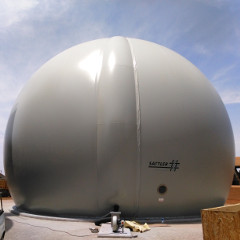
A 2,150 m³ double-membrane gas holder giving the works steady sewage gas for utilisation.
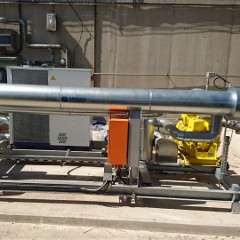
A de-humidification and boosting skid pushing brewery biogas one kilometre to the boiler house.
Share your gas flow, composition and end use and we will size the right equipment and tell you what it will cost to run.